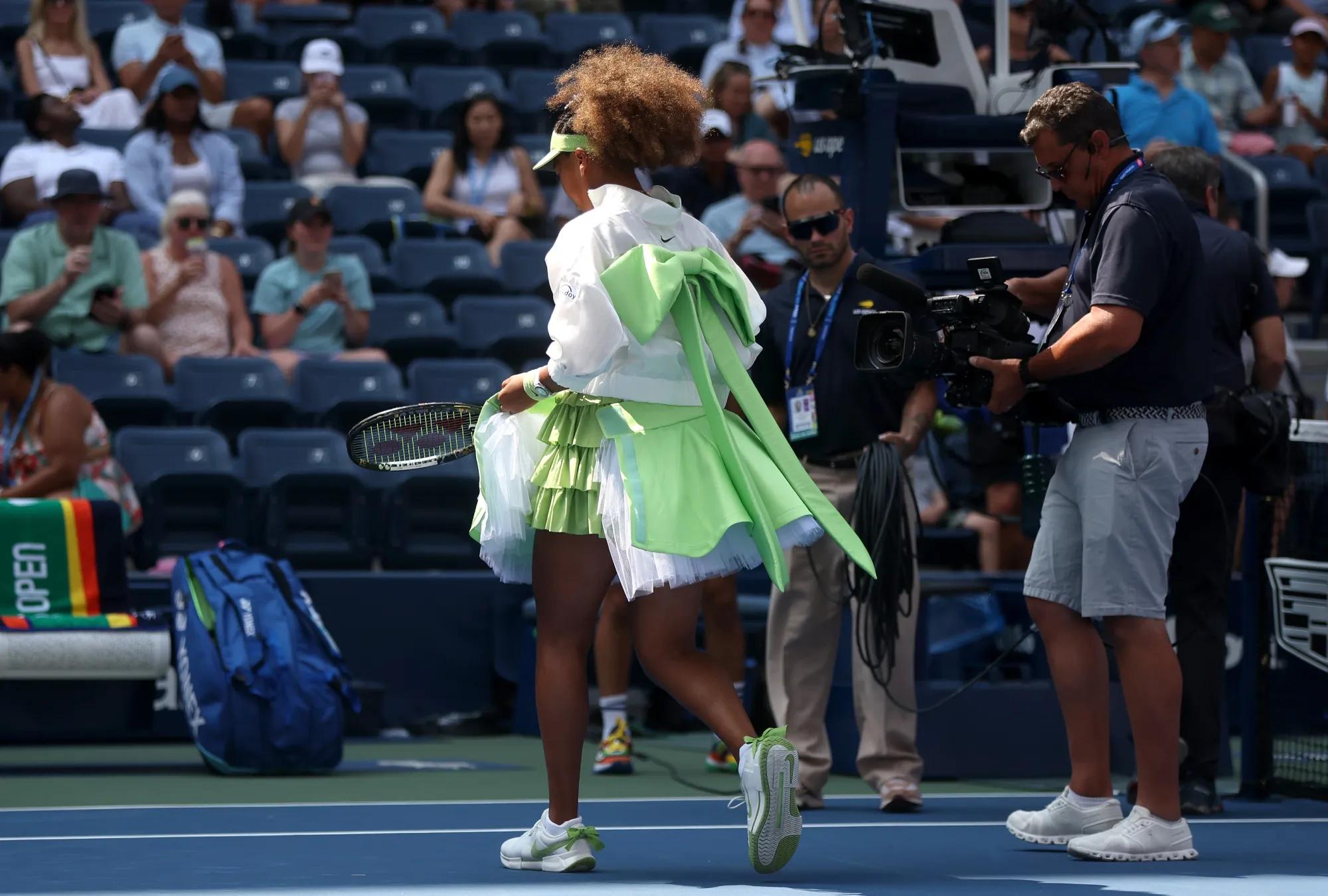
At the U.S. Open, Naomi Osaka Is Changing What the Court Is For
The tennis court used to be a place where women were expected to perform. Naomi Osaka is increasingly treating it as a place to express. At the U.S. Open, Osaka has made her entrance almost as interesting as the match itself. Working with stylist Law Roach and designers including Thom Browne, she has turned her on-court wardrobe into a deliberate collision of tennis, high fashion, streetwear, sports history and pop culture. The looks are dramatic, referential and unmistakably hers. They are also doing something bigger than generating fashion headlines. They are changing the expectations around what a female athlete gets to be.
This is not new. It is just getting harder to ignore.
Florence Griffith Joyner understood the power of visual identity decades ago. Flo-Jo’s one-legged racing suits, elaborate nails, and unapologetic glamour made her instantly recognizable at a time when female athletes were still expected to look appropriately athletic and, preferably, not too distracting. Jackie Joyner-Kersee brought her own distinctive presence to track and field. Serena Williams turned the tennis court into a place where performance, femininity, fashion and cultural identity could coexist, whether she was wearing a catsuit, a tutu or denim-inspired tenniswear.
What Osaka is doing feels particularly of the moment because the culture around sports has changed. The athlete is no longer just an athlete. She is a fashion figure, creator, celebrity, entrepreneur and cultural participant, sometimes all before breakfast. For a generation that moves between TikTok, music, fashion, gaming, sports and entertainment without seeing hard boundaries between them, that makes perfect sense.
Osaka’s recent looks understand this ecosystem. One of her U.S. Open outfits referenced Allen Iverson, connecting tennis to basketball and to a particular history of athlete-driven style. Another brought high-fashion theatricality onto a court where the traditional uniform has historically been designed to disappear into the performance. The message is subtle but powerful: I don’t have to leave the rest of myself in the locker room. That is an important evolution in women’s sports.
For decades, athletes who pushed the boundaries of appearance were often treated as distractions from the serious business of competition. Now the visual identity of an athlete can become part of the competition for attention itself. A tunnel walk, a pregame outfit, a tennis entrance, or a postgame look can travel around the world before the first point is played.
The fashion industry understands this. So does sports marketing. The interesting question is whether brands understand what is actually happening. The opportunity is not simply to put a logo on an athlete with a large following. It is to understand the cultural world that athlete already inhabits. Osaka’s appeal isn’t reducible to tennis. Neither is Coco Gauff’s. Neither is Serena’s. Their cultural influence comes partly from the fact that audiences see them as people with identities and points of view, not just performers delivering a sporting product. That changes what a successful partnership looks like.
The most interesting collaborations increasingly feel less like endorsements and more like cultural participation. The athlete brings an existing point of view. The brand brings resources, creative capability, and reach. The resulting work feels like something that could only have happened with that particular person, rather than something that could have been handed to any athlete with enough followers.
And this is where the generational shift becomes especially important. Younger consumers are not separating their interests into neat categories. They can discover a tennis player through a fashion account, follow a designer because of a basketball player, buy a shoe because of a musician, and become interested in a tournament because the athletes have become part of the cultural conversation. Sports are not competing with fashion for attention. They are increasingly part of the same attention economy. The court, in other words, has become content.
But content is only part of the story. What Osaka and the women who came before her demonstrate is that style can also be a form of agency. It allows an athlete to decide how she enters the room before anyone else decides what she represents.
That matters particularly for women of color, who have historically had their bodies, appearance, and identities interpreted through other people’s expectations. Style becomes another way of saying: you don’t get to define me before I define myself. That is why Osaka’s fashion choices resonate beyond fashion. She is not just making tennis prettier. She is helping expand the cultural definition of the athlete.
And brands should pay attention, because the next generation of sports consumers is not looking at athletes through a single lens. They are watching for personality, identity, taste, humor, community, and cultural relevance alongside performance. They want the person, not just the player.
The old sports marketing question was, “How many fans does this athlete reach?”
The more interesting question now is, “What worlds does this athlete connect?”
That is where the real cultural value sits. The crossover between sports and fashion is no longer a side story. It is becoming one of the ways culture moves. And athletes like Naomi Osaka are not simply participating in that shift. They are wearing it onto the court.
Culture moves before the market does. Jembe Intelligence helps brands see what’s shifting, understand why it matters, and act before everyone else catches up.