Nike Lost the Culture It Helped Create
Nike has spent decades teaching brands how to become more than brands. The Swoosh became shorthand for ambition. Air Jordans became cultural currency. Athletes became celebrities, celebrities became athletes, and sneakers became a language of identity that could move from the basketball court to the street to the runway without asking permission.
Nike understood something that most brands spend millions trying to figure out: culture is not a marketing channel. It is the environment in which a brand lives. Now Nike is learning the other side of that lesson.
The company’s stock is down more than 40% this year and nearly 80% from its 2021 peak. On September 21, Nike will be removed from the S&P 100 after nearly 18 years in the index, although it will remain in the S&P 500. The numbers are financial, but the problem they expose is cultural. One of the brands that once seemed almost synonymous with cultural relevance is trying to figure out how to become relevant to the next generation again.
And one of Nike’s most important athletes has a pretty simple idea about where it should start.
In July, LeBron James was asked what Nike could do to regain momentum. His answer was not about a new sneaker, a better campaign, or another celebrity partnership. “You got to get back into the roots,” he said. Then he got more specific. He talked about Nike getting “back to being out in the inner city,” having people in communities talking to younger generations, asking them what they like, what they don’t like, how they feel about things.
That is a remarkable thing for one of the world’s most sophisticated marketing organizations to hear from one of the athletes who helped build its modern cultural mythology. He basically told them to go touch grass. Go listen. Talk to people. Find out what they actually care about. In other words, stop assuming you already know. That may be the most important lesson in Nike’s current struggle.
Nike did not become Nike because it had a beautiful logo or because it made technically excellent shoes. It became Nike because it understood what those shoes meant.
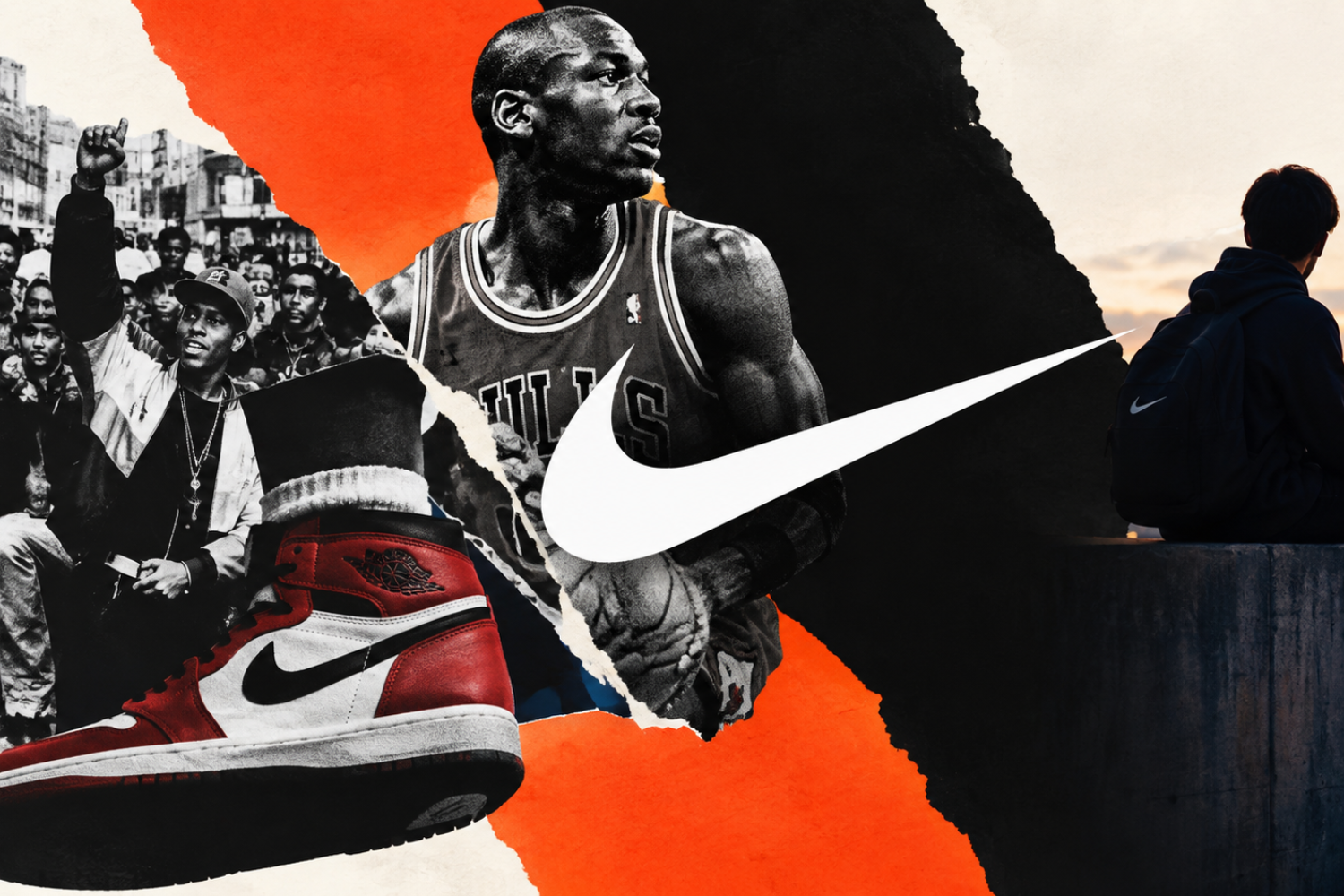
Michael Jordan was never just a basketball player with a sneaker contract. Run-DMC was never just a musical act wearing Adidas. Serena Williams was never just an elite tennis player in performance apparel. Nike understood that sport was connected to music, fashion, identity, race, ambition, aspiration, and community. It understood that the product was often the entry point into something much larger. Nike didn’t simply sell sneakers. It sold participation in a culture. That was the genius. And that is exactly why heritage can become dangerous.
The longer a brand is successful, the easier it becomes to confuse cultural memory with cultural relevance.
A brand remembers the moments when everyone wanted to be associated with it. It remembers the campaigns people still talk about. It remembers the athletes who changed everything. It remembers the products that became cultural objects. Then, slowly, it begins to believe that the meaning belongs to the brand. It doesn’t. Culture doesn’t owe anyone loyalty. Not Nike. Not Coca-Cola. Not Levi’s. Not Disney. Not anyone.
Consumers can love what a brand represented ten years ago and have absolutely no interest in what it represents now. They can wear the old sneaker and ignore the new one. They can remember the campaign and scroll past the next one. They can admire the history and still decide another brand feels more like them.
That is the brutal thing about cultural relevance. It expires. And there is no notification when it happens. Jembe Intelligence research points to the broader consumer expectation brands are operating within. In our recent research, 40% of respondents said they are somewhat more likely to trust a brand that publicly aligns with social or cultural causes. The implication isn’t that every brand needs to start taking public positions on everything. It is that consumers increasingly evaluate brands through a cultural lens, not simply through product performance or price.
The relationship between consumer and brand has become more complicated because culture has become part of the product experience. A shoe is not just a shoe when it says something about who you are. A restaurant is not just a restaurant when it becomes part of a neighborhood’s identity. A beauty product is not just a beauty product when the person recommending it understands your experience. A sports brand is not just selling performance when its athletes are simultaneously fashion references, creators, celebrities, and cultural figures.
The product exists inside a world. And that world keeps changing. This is where brands get themselves into trouble. They keep researching the consumer while failing to understand the culture surrounding the consumer.
They know what people bought last quarter. They know what content performed last month. They know which demographic has the highest purchase intent. They know which campaign drove awareness. But they may not know why a particular sneaker suddenly feels old. They may not know why a young consumer who once wanted to look like an athlete now wants to look like a creator. They may not know why a community that once made their brand cool has moved on. They may not know what is happening in the neighborhood until the neighborhood has already moved somewhere else.
Jembe Intelligence research has found that only 13% of Black consumers say most advertising campaigns reflect their lived experience very well. That finding is specific to Black consumers, but the underlying warning is much broader: reach is not understanding. A brand can have enormous amounts of consumer data and still make people feel like it doesn’t see them. That is the cultural blind spot. And it is particularly dangerous for legacy brands because legacy creates the illusion that you already understand your consumer.
Nike’s current strategy suggests the company knows this. Under Elliott Hill, Nike has reorganized around individual sports and smaller teams tasked with understanding specific consumers, rather than treating the business as one enormous consumer ecosystem. Hill has talked openly about getting Nike back to sport and rebuilding the company’s connection to athletes. That is directionally important. But there is a difference between reorganizing a company around consumer segments and actually being close enough to culture to notice what those consumers are becoming.
LeBron’s comments get at that difference. He didn’t say Nike needs another dashboard. He didn’t say Nike needs another segmentation study. He said it needs to get back into the communities. Because sometimes the most important cultural intelligence isn’t sitting inside a spreadsheet. It’s sitting on a basketball court. It’s in what teenagers are wearing before a trend report gives it a name.
That is why cultural intelligence cannot be something brands pull out when they’re launching a campaign. It has to be an operating discipline. The question shouldn’t be, “What is trending?”
It should be, “What is changing?” Those are not the same question. A trend is visible. A cultural shift often isn’t.
By the time a trend report tells you that everyone is doing something, brands are already arriving late to the party. The more interesting work happens earlier, when a behavior looks small, strange, or insignificant and someone asks why it is happening. That is where brands can find the signal. Nike once had an extraordinary ability to do that.
It saw basketball culture before basketball culture became a global marketing category. It understood sneaker culture before every luxury house wanted a sneaker. It understood the athlete as a cultural personality before athlete influence became a media strategy.
The irony is that Nike’s greatest competitive advantage may have been its willingness to listen to culture before it was obvious. Its vulnerability may be what happens when a brand gets so big that it stops listening with the same urgency. This is the paradox of heritage. The thing that made you culturally relevant can eventually make you believe you don’t have to work to remain culturally relevant. Except you do. Every day. The consumer does not care that you were cool.
The consumer cares whether you are connected to the world they are living in now.
That doesn’t mean legacy brands should abandon their histories or chase every emerging aesthetic. Quite the opposite. The strongest brands know how to use heritage as raw material rather than a museum exhibit.
Nike doesn’t need to stop being Nike. It needs to understand what being Nike means to the next generation. That requires going back to the places where the brand was originally built, not to recreate the past, but to listen for what comes next. There is a crucial difference between returning to your roots and retreating into nostalgia. Nostalgia asks, “How do we make people remember what we were?” Cultural intelligence asks, “What are people becoming, and what does that mean for us?”
Nike’s problem, then, is bigger than sneakers, distribution, or a stock price. It is the problem every legacy brand eventually faces. How do you remain culturally relevant after everyone already knows who you are? The answer is not to rely more on the things that made you famous. It is to stay curious enough to notice what is happening around you. Because heritage can get you invited into the conversation. It cannot guarantee that anyone still wants to hear what you have to say. Culture moves forward constantly. The brands that move with it stay relevant. The ones that rest on what they once meant may eventually discover that the culture that made them famous has moved on without them.
Jembe Intelligence helps brands move beyond demographic labels to understand the cultural, emotional, and behavioral signals shaping discovery, trust, and loyalty. Because knowing who your consumer is only gets you so far. The competitive advantage comes from understanding what makes them believe, choose, and stay. The brands that figure that out won’t just be more relevant. They’ll be harder to leave.
The brands that figure that out will not just be more culturally relevant. They will be harder to leave. Request a demo of Jembe Intelligence and get the insights you need to become the brand consumers don’t want to leave.